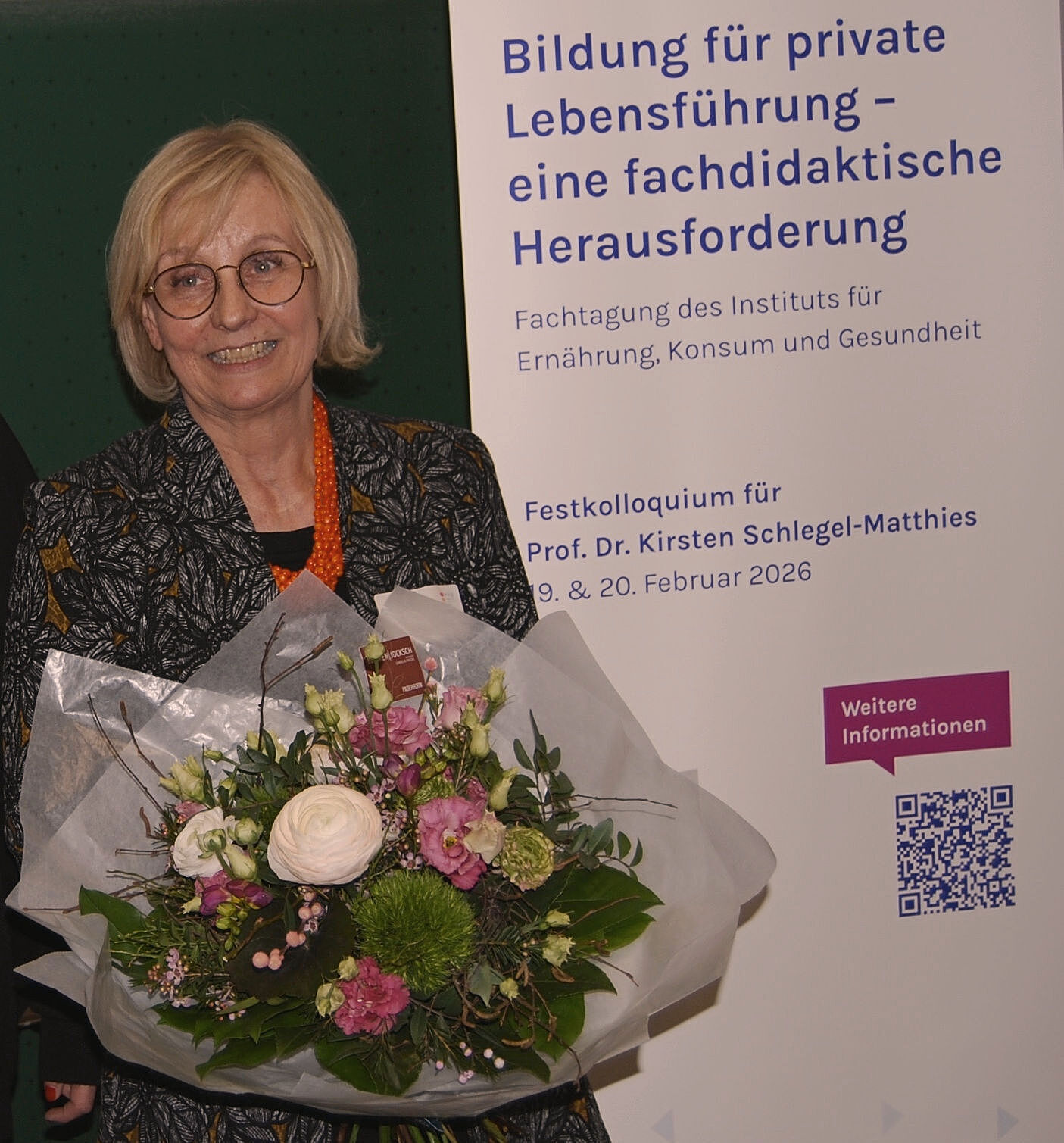
Paderborn University bid farewell to Prof. Dr Kirsten Schlegel-Matthies on 1 March 2026 with a specialist conference and a celebratory colloquium - after more than two decades of work in home economics and the didactics of home economics. The Institute of Nutrition, Consumption and Health organised the celebratory colloquium "Education for private lifestyles - a didactic challenge". Kirsten Schlegel-Matthies' broad expertise in the fields of consumer research, consumer policy, education for sustainable development, the history of household-related education and the development of curricula for nutrition and consumer education in Germany, Austria and Switzerland was evident in the welcoming speeches and presentations.
The focus of the symposium was on emphasising the relevance of subject-specific didactics for profession-oriented teacher training and the professionalisation of teacher training at Paderborn University. Schlegel-Matthies played a key role here. This also included the development of the subject area of home economics away from an education for the poor and girls towards a modern nutrition and consumer education for all pupils, especially in the context of the "REVIS" project (reform of nutrition education in schools).
From a historical perspective, reference was made to the "new household" and the socially responsible creation of living space in the early 20th century, as well as today's challenges of sustainable living in private households. Particular attention was paid to the difficulties of regulating online marketplaces, which often use unfair methods and are difficult to understand, and thus to the responsibility of consumer policy
Education in the field of consumption, nutrition and health requires dealing with controversy. Successful nutrition and consumer education is therefore not about imparting supposedly "right" or "wrong" knowledge about food or consumption. Teaching is not about indoctrination, but about empowering people to argue and make considered judgements. The presentations made it clear that household-related education makes an important contribution to political education.
Furthermore, consumer education is inconceivable without consumer policy and corresponding school development. In a moderated discussion, representatives of the D-A-CH associations(HaBiFo Haushalt in Bildung und Forschung Deutschland; TNE Thematisches Netzwerk Österreich; FD-WAH.CH Fachdidaktik Wirtschaft - Arbeit - Haushalt Schweiz) argued that nutrition and consumer education should be mandatory and interdisciplinary in all school types and grades and that the existing subject of home economics should not be subject to further cuts in teaching hours.